
Known Knowns. Known Unknowns - Is Britain’s Economy Destabilising?
“There are known knowns... There are known unknowns... But there are also unknown unknowns... and it is the latter category that tend to be the difficult ones.” - Donald Rumsfeld (2002)
In 2007, the world learned too late that the mortgage market had been quietly undermining global finances.
In 2026, Britain risks repeating that same mistake, not with subprime loans, but with the vulnerability of the physical and digital systems that underpin our economy.
The climate isn’t the hazard anymore.
System failure is.
We are living through a pattern we can no longer ignore.
Last spring that was the driest in 132 years.
Last summer had four heatwaves and the hottest temperatures since 1884. Grass that turns brown by May and hosepipe bans in October.
And then the rain arrives. All at once.
Floods follow droughts. Droughts follow floods. The climate is stuck on a seesaw, bouncing between each side harder every year.
The British climate, once defined by gentle unpredictability, is becoming hotter, wetter and far more extreme.
But the real story isn’t the extremes themselves.
It is what those extremes do to the systems we rely on every day.
Climate extremes test the resilience of critical infrastructure, upon which the economy relies.
The next flood might not reach your front door. But it can still derail your morning commute. Cancel the school bus. Shut the roads.
You settle in at home to work, only to find that a storm thousands of miles away has frozen cloud servers, delaying bank payments and disrupting your day.
While we experience impacts individually, we are each dependent on the reliability of a shared engine. The UK economy.
We are all standing on the same Jenga tower. And climate change isn’t tapping at the top.
It is pulling out the blocks at the base. Undermining the foundations.
The structure is beginning to wobble.
The Known Knowns
Climate change is no longer subtle. If it were a dot-to-dot, we’re starting to see the outline appear.
Temperatures are rising.
2025 was the hottest year on record in the UK.
The water cycle is shifting.
July to December 2023 was the wettest period in 130 years.
The flooding of the River Monnow in 2025 shows the pattern clearly. The same thing happened in 2024. And again in 2020.
A month of rain in a single day.
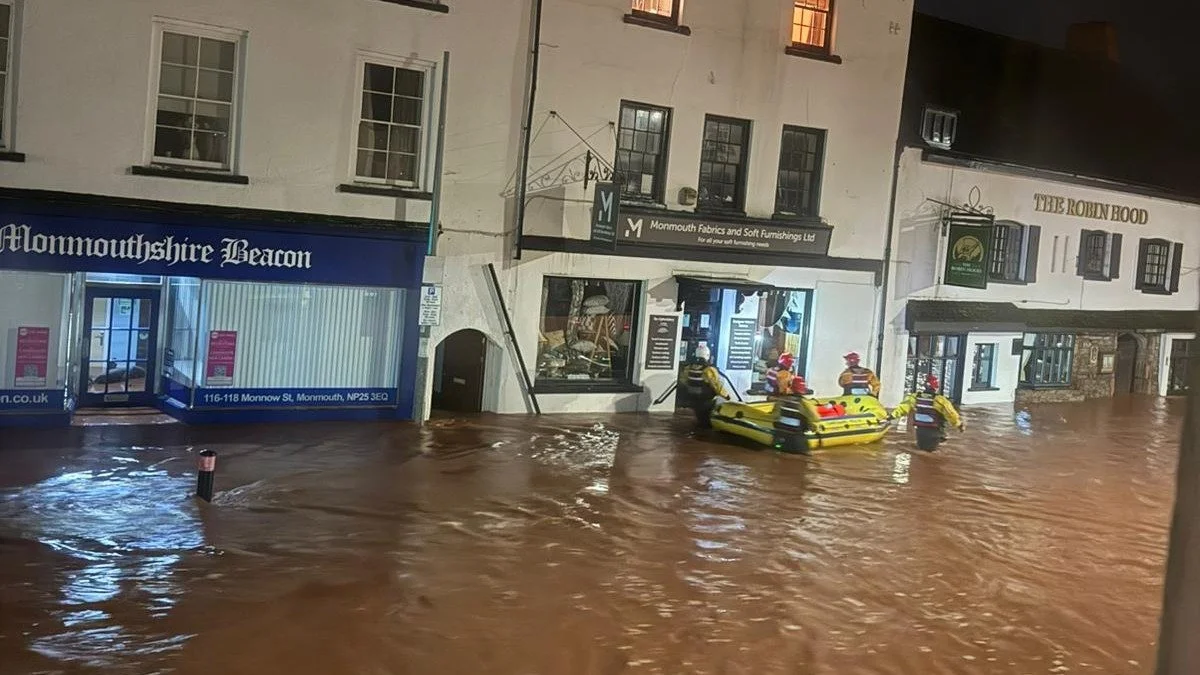
For the second time in two years, the River Monnow bursts its banks.
Homes destroyed. Businesses shuttered. Flood insurance is either unaffordable, or simply unavailable.
Calls for improved flood defences ring loud. In a shifting climate, how many years will they hold out?
Floods of the century are becoming annual events.
We see these events on the news. We might know the people affected.
But these are only the immediately visible impacts.
This is just the surface.
Known Unknowns
Essential infrastructure is increasingly exposed to climate extremes.
Roads.
Railways.
Supermarkets.
Electricity substations.
Water networks.
Data centres.
We know the assets.
We can’t predict how often they will fail.
But when they do, the consequences are clear.
And that sits at the heart of our national resilience problem.
In March 2025, a fire at the North Hyde substation near Heathrow grounded over 1,300 flights, left 67,000 homes without power, and sent disruptions through global supply chains.
It wasn’t climate-related. But it showed how much can fail when one node collapses. The consequences cascaded.
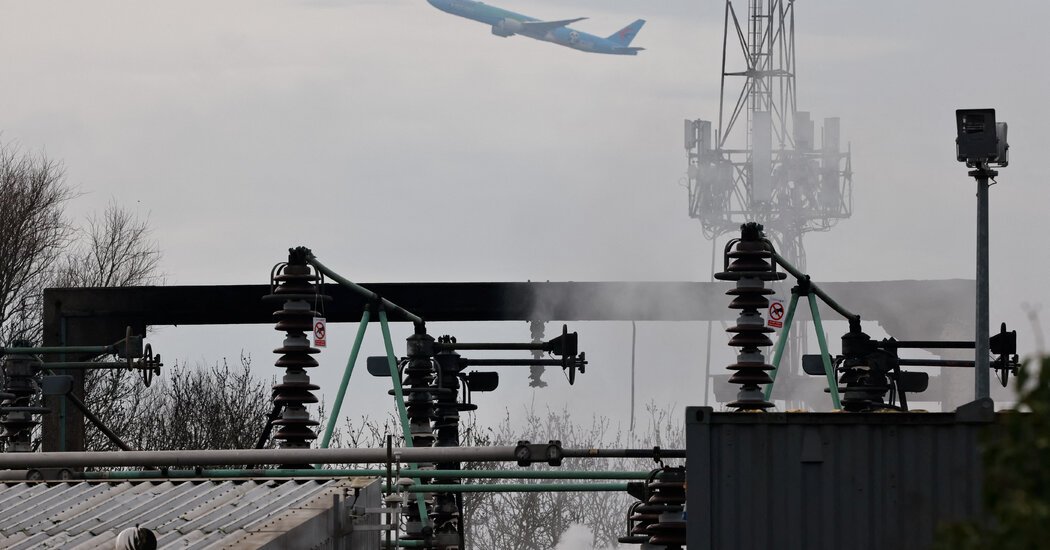
The knock-on effects of a single failure event at one point of a network can have drastic and far-reaching consequences
A substation failure in West London froze signaling. suspending sections of the Piccadilly Line for hours. Stations closed, thousands of work hours lost, with millions in productivity vanishing by midday.
Recent weather has only reinforced this fragility.
A major motorway bridge on the M48 Severn closed in both directions due to structural defects, disrupting 80,000 drivers daily.
A landslip derailment on the West Coast Main Line caused commuter chaos across Cumbria.
Ahead of Storm Claudia, rail operators warned of severe delays ahead, causing network-wide cancellations.
Dawlish showed us the same vulnerability in February 2014.
A ferocious storm. A single railway line. The lifeblood of the region.
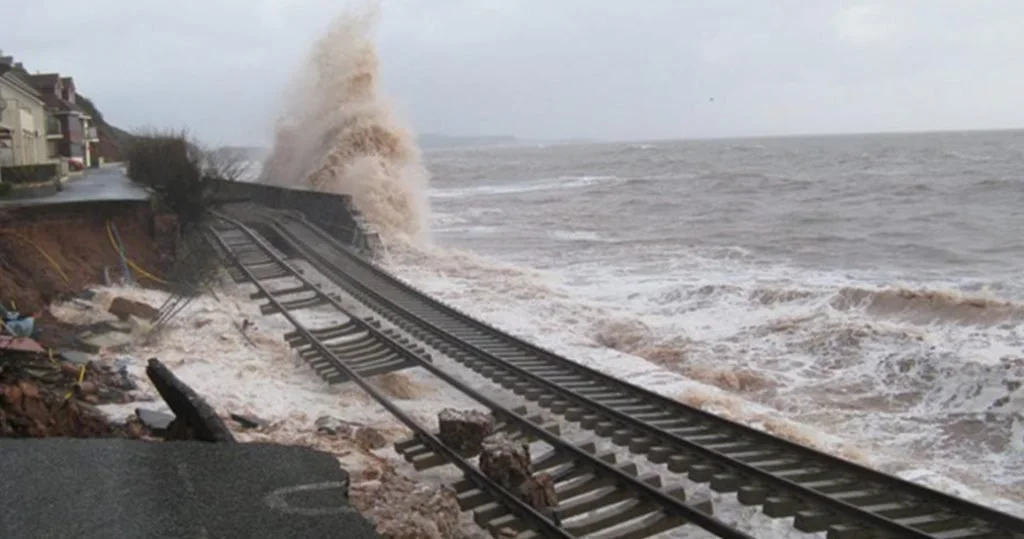
The remains of the railway line at Dawlish after the storm destroyed the sea wall and undermined the tracks.
Dangling in the breeze like a suspension bridge. Nothing to support it, the land underneath totally washed away.
50 towns and cities across the Southwest cut off from the rest of the railway.
For 8 weeks.
Critical infrastructure, completely offline.
£35 million to repair. But £1.2 billion in wider economic damage from the downtime.
These were one-off events. One railway line. One electricity substation.
Single points of failure.
Not anomalies, but early warnings.
Our infrastructure was not designed for the climate we face today, let alone for the challenges ahead.
The Fragile Underpinnings of the Economy
Even if the climate shocks don’t reach your front door, they reach your life.
Energy powers services.
Transport moves goods.
Logistics run supply chains.
Data synchronises everything.
Take one out and the whole machine starts to judder.
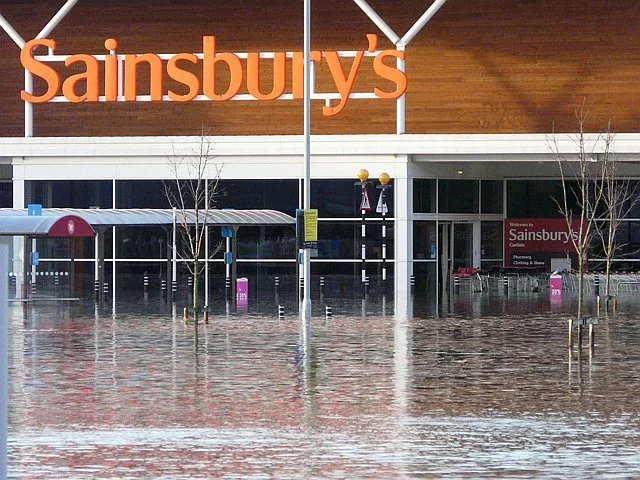
Flooded Sainsburys supermarket in Church Street, in the Caldewgate district of Carlisle.
Ports feed supermarkets.
Roads feed ports.
Transport feeds labour.
Labour feeds productivity.
And underpinning all of it are 400,000 electricity substations. Many are decades old, often in flood-prone zones, built for a stable climate, rather than a volatile one.
The Heathrow incident showed us what happens when one goes offline.
Now imagine the same event caused by floodwater rather than fire.
And not just one substation, but hundreds.
Not just a local inconvenience, but a national risk event.
If one in four UK homes will face high flood risk by 2050, then one in four substations will too. And with 38% of the national road network projected to be climate-impacted, we are heading for a world where infrastructure fails as frequently as the homes it serves.
This is the scenario we’re not modelling.
The cost we’re not pricing.
The failure at Heathrow cost the UK economy over £4 million per day in lost revenue.
From 1 substation.
The Bank of England’s Climate Financial Risk Forum has shown that adaptation investments can reduce expected losses by almost half and cut tail-risk default probabilities by more than 75%.
Resilience isn’t an environmental nice-to-have.
It’s financial risk management.
GDP1 – The Daily Output We Can No Longer Take for Granted
The UK had a GDP of £2.78 trillion in 2024, roughly £7.5 billion per day.
Call that GDP1 - the daily economic output that Britain must generate to sustain wages, public services, investment and national credibility.
Climate volatility is eroding GDP1 from all sides.
Flooded high streets and business that never fully recover.
Rail disruption keeping thousands from work.
Freight stranded on blocked roads.
Rising insurance costs for everyone.
Once or twice a year is manageable.
But shocks are becoming more frequent, less predictable and more interconneted than ever before.
UK economy downtime compounds, productivity decays.
The economy shrinks. Investment dries up. Companies falter.
Growth falters.
And flooding is going to get worse.
Flood events drive up everyone’s insurance prices, with the ABI showing that average home and contents insurance premiums increased by £55 from 2023 to 2024.
The average increase.
Including people who have never even been flooded.

Flood graph demonstrating how surface water flooding is expected to worsen as we move towards 2050.
Source: One in five UK supermarkets at risk from floods | The Grocer
When natural systems fail, the cost doesn’t disappear; it migrates.
Households --> high bills
Employers --> lost output
Sponsors --> delayed projects
Pension savers --> weaker returns
But when natural infrastructure functions, it protects the very assets and communities our economy relies on.
This is no longer an environmental issue.
It’s an economic one.
Resilience: The Cheapest Day of GDP You’ll Ever Buy
Every failure carries a cost.
But resilience delivers a return.
It depends entirely on maintaining the connections between them.
Public First estimates that £1 invested in flood resilience yields £8 in savings. Upland restoration of catchments reduces downstream flood risk. Natural systems are critical infrastructure.
Nature-based resilience pays for itself, often many times over, and far more efficiently that concrete.
No longer just a CSO issue, but a CFO one.
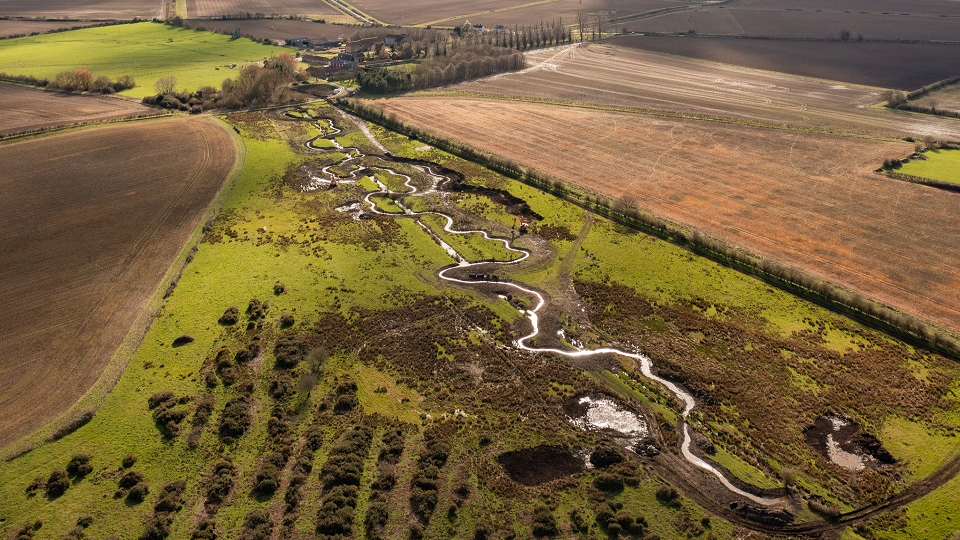
Allowing the river to flood higher in the catchment on its original floodplain reduces downstream flood risk.
Natural systems are critical infrastructure:
They slow water.
Store water
Filter water.
Protect assets.
Reduce risk.
Stabilise cashflow.
This isn’t CSR.
It’s economic stabilisation.
It’s a fiduciary duty.
It’s national competitiveness.
What Leaders Must Do Next
1. Secure critical infrastructure in high-risk areas
Protect or retrofit substations, hospitals, data centres and utilities in flood zones.
2. Restore upper catchments and floodplains
Slow water at source to reduce downstream flood peaks and costs.
3. Build resilience into financial and corporate disclosure
Integrate resilience KPIs into planning, investment and reporting.
4. Price resilience into markets
Ensure that risk reduction from nature and adaptation is reflected in insurance, credit, and cost of capital.
The Jenga Tower Wobbles
You may never see the substation that powers your hospital.
You may never think about the servers that run your bank account.
You may never notice the logistics centre that keeps your supermarket stocked.
But you feel their absence immediately.
The UK economy is a Jenga tower of interdependence.
Climate change isn’t knocking at the top.
It’s shifting the blocks at the bottom.
The tower isn’t falling. Not yet.
But it’s starting to wobble.
Resilience is how we keep it standing.
How we keep the country running.
How we give the next generation a stable foundation in an unstable climate.
Because the cost of resilience is always lower than the cost of being unprepared.